
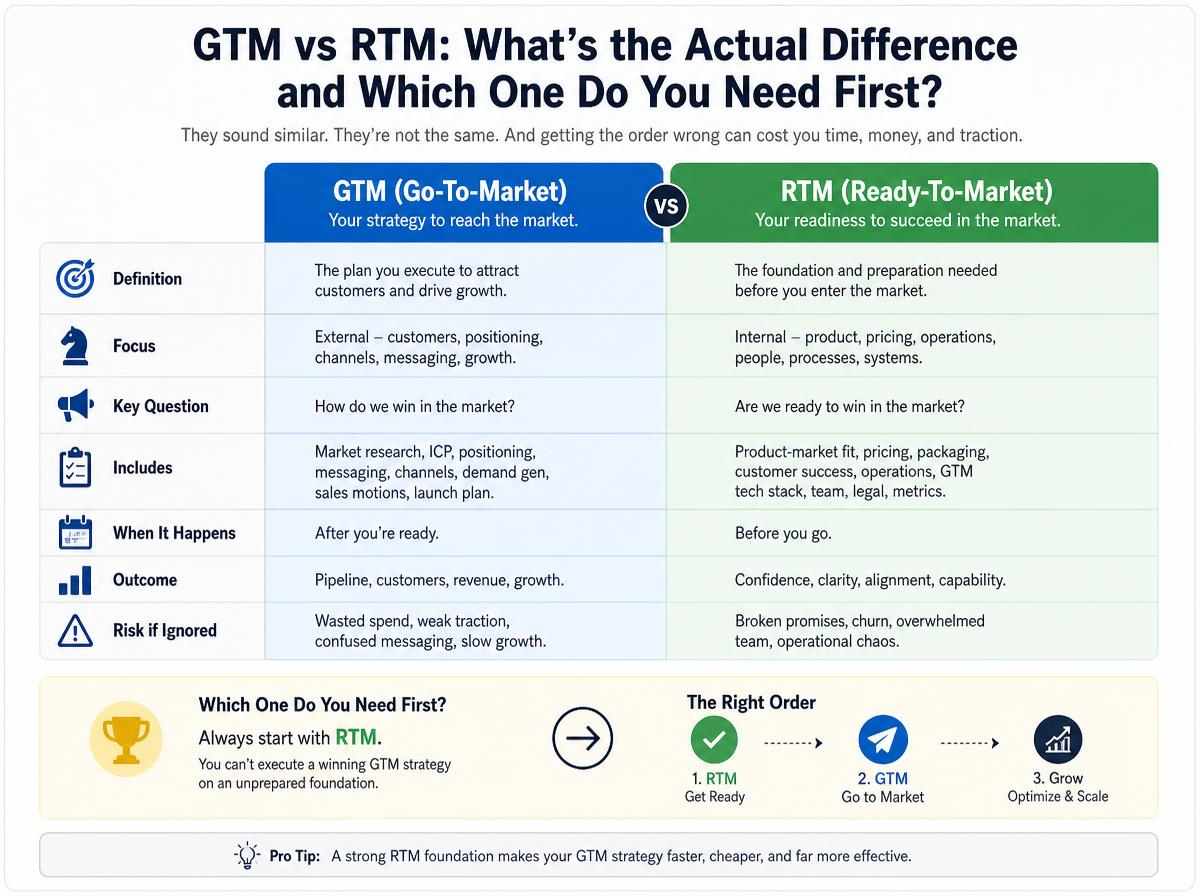
A founder in Lahore just finished building her product. Marketing wants a “GTM plan.” Sales wants an “RTM strategy.” Nobody in the room agrees on what either term actually covers, and the meeting ends with three different documents that contradict each other. This mix-up happens constantly, and it happens because most explanations treat GTM and RTM as interchangeable jargon instead of what they really are: two different layers of the same launch decision.
GTM (Go-to-Market) is the full plan for how a product reaches its buyer — positioning, pricing, messaging, and timing. RTM (Route-to-Market) is the narrower question of which physical or digital channel actually delivers the product into the customer’s hands. One sets the direction. The other builds the road.
What Is GTM (Go-to-Market)?
A Go-to-Market strategy is the complete plan a company uses to introduce a product to a defined market and convert that market into paying customers. It answers who the buyer is, why they should care, what they’ll pay, and when the launch happens.
GTM sits above everything else. It’s the strategic layer that decides:
- Target segment — which industry, company size, or consumer group gets targeted first
- Positioning and messaging — the specific problem the product solves and why it beats the alternative
- Pricing model — subscription, one-time, freemium, or tiered
- Launch sequencing — soft launch, regional rollout, or full-market push
- Sales motion — self-serve, inside sales, or field sales
In our review of GTM plans used by early-stage SaaS teams in Karachi and Islamabad, the plans that work share one trait: they name a single primary segment instead of trying to serve everyone in month one. A GTM document that lists five target audiences usually signals the team hasn’t made a decision yet — it’s a wish list, not a strategy.
What Is RTM (Route-to-Market)?
Route-to-Market is the operational plan for which channel actually moves the product from company to customer. It is a subset of GTM, not a replacement for it.
RTM decisions typically include:
- Direct-to-consumer — company website, app store, or owned e-commerce
- Retail and distributor networks — physical shelf space through wholesalers
- Marketplace channels — Daraz, Amazon, or category-specific platforms
- Partner and reseller channels — value-added resellers or system integrators
- Hybrid models — combining two or more of the above by region or segment
RTM is where the plan meets logistics: warehousing, margin splits with distributors, channel conflict, and delivery timelines. A GTM strategy can be excellent on paper and still fail if the RTM choice doesn’t match the buyer’s actual purchasing habit — for example, targeting rural Punjab retailers with a direct e-commerce-only route, when cash-on-delivery through local distributors is what that buyer actually trusts.
GTM vs RTM: Side-by-Side Comparison
| Factor | GTM (Go-to-Market) | RTM (Route-to-Market) |
|---|---|---|
| Scope | Entire market entry strategy | Distribution and delivery channel only |
| Core question | Who do we sell to, and why should they buy? | How does the product physically or digitally reach them? |
| Owned by | Product marketing, leadership | Sales operations, channel/distribution teams |
| Timeframe | Set before launch, revisited quarterly | Adjusted continuously as channels perform |
| Example decision | Target mid-market retailers in Punjab first | Sell through distributors vs. direct online store |
| Failure mode | Wrong audience or message | Right audience, wrong delivery path |

Notice that RTM sits inside GTM, not beside it. Every RTM decision should trace back to a GTM choice made earlier. When a company changes its RTM without revisiting the GTM assumptions behind it, that’s usually where channel conflict and pricing confusion start.
Why This Distinction Actually Matters for Pakistani Businesses
For businesses operating in Pakistan, the GTM-RTM split isn’t academic — it changes real outcomes. We have seen teams in the Lahore FMCG space build a strong GTM strategy around premium positioning, then default to the same RTM (general trade distributors) their competitors use, which quietly undercuts the premium message with discount-driven shelf placement.
The mismatch shows up most often in three scenarios:
- D2C brands entering tier-2 cities. A GTM plan built around Instagram and website checkout assumes digital payment comfort and courier reliability that doesn’t hold uniformly outside major metros. The RTM needs a cash-on-delivery and local pickup layer the original GTM never accounted for.
- B2B SaaS selling to enterprise buyers. GTM might correctly identify CFOs as the buyer persona, but the RTM — self-serve signup — doesn’t match how enterprise buyers in Pakistan actually procure software, which is relationship-led and requires a direct sales RTM instead.
- Manufacturers exporting regionally. GTM defines the target country and buyer type, while RTM has to solve for customs, local distributor relationships, and currency exposure — details that don’t belong in the GTM document at all.
What Happens When the “Textbook” GTM Fails
Most articles on this topic assume a clean, linear process: build GTM, then build RTM, then launch. In practice, that order breaks down for a specific and common case — startups with a limited budget and no existing distribution relationships.
If a company can’t afford a dedicated field sales team or existing retail relationships, the textbook GTM (define segment, then choose the “ideal” channel) collapses because the ideal channel is often inaccessible at the budget available. For these teams, the practical fix is to let RTM constraints inform GTM from day one, rather than treating RTM as something decided after the strategy is locked. A startup with three sales reps and no distributor contracts should build its GTM around channels it can actually execute — digital-first, marketplace-led — rather than aspiring to a retail RTM it has no relationships to support.
This is the gap most beginner guides skip: GTM and RTM aren’t strictly sequential. For resource-constrained teams, they need to be built together.
GTM vs RTM at Different Business Stages
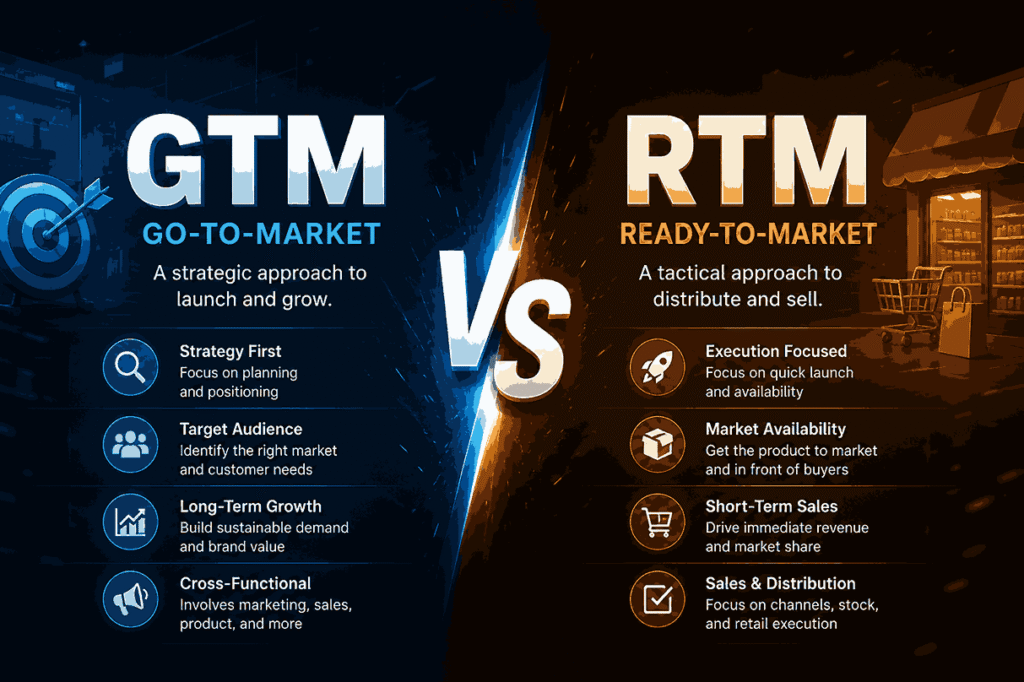
| Stage | GTM Focus | RTM Reality |
|---|---|---|
| Pre-seed / early startup | Narrow segment, message-market fit | Usually direct/digital only — no budget for channel partners |
| Growth stage | Segment expansion, competitive positioning | Mix of direct and 1–2 partner channels |
| Established / enterprise | Multi-segment, regional strategy | Full multi-channel RTM: distributors, retail, direct, marketplace |
Common Mistakes When Confusing GTM and RTM
- Treating RTM as the whole strategy. Picking a distribution channel without first defining the target buyer leads to generic, unfocused marketing.
- Locking GTM before checking channel feasibility. A brilliant positioning strategy is worthless if the chosen RTM can’t reach the target segment cost-effectively.
- Never revisiting RTM after launch. Channels that worked at launch often underperform at scale — a distributor RTM that worked for 50 retail points may not work at 500.
- Copying a competitor’s RTM wholesale. Two companies can share a GTM-level target market and still need entirely different RTMs based on capital, team size, and existing relationships.
Before finalizing either document, it’s worth auditing your current setup against this list — most GTM failures trace back to one of these four mistakes, not to the product itself.
GTM vs RTM: Which Do You Build First?
Build GTM first when you’re entering a genuinely new market or launching a new product category — you need the strategic direction before you can evaluate channel options. Build RTM considerations in parallel when your budget or existing relationships already limit your channel choices, because in that case, the “ideal” GTM strategy has to bend to what’s actually executable.
There’s no universal answer here, and any article claiming otherwise is oversimplifying. The right sequence depends on capital, existing distribution relationships, and how established the category already is in your target market.
Frequently Asked Questions
What is a GTM strategy in simple terms?
A GTM (Go-to-Market) strategy is the full plan for how a company brings a product to its target buyer, including who to target, how to position the product, what to charge, and when to launch. It’s the strategic umbrella that every other launch decision, including RTM, sits under.
What is RTM in business?
RTM (Route-to-Market) is the specific channel or combination of channels — direct, retail, distributor, or marketplace — used to physically or digitally deliver a product to the customer. It’s the execution layer of a broader GTM strategy, not a standalone plan.
Is RTM part of GTM or separate from it?
RTM is part of GTM. It’s one component within the larger Go-to-Market strategy, specifically covering distribution and delivery. A company can’t build a complete GTM plan without eventually defining its RTM.
Can a company have one GTM but multiple RTMs?
Yes. A single GTM strategy commonly uses multiple RTMs — for example, direct online sales for one customer segment and distributor-based retail for another — as long as both routes align with the same underlying positioning and pricing set in the GTM.
What’s the biggest mistake companies make with GTM vs RTM?
The most common mistake is finalizing GTM without checking whether the intended RTM is actually feasible with the available budget and team. This leads to strategies that look strong on paper but can’t be executed with existing resources.
Does RTM change after launch?
Yes, and it should. Channels that perform well at a small scale often need adjustment as sales volume grows — a company selling through five local distributors may need to renegotiate or add channels once it reaches fifty.
Is GTM only relevant for new products?
No. GTM strategy also applies to entering new markets, launching a new pricing tier, or repositioning an existing product against new competitors — any time a company changes who it’s targeting or how it’s reaching them.
How does RTM differ for B2B vs B2C companies?
B2B RTM usually involves direct sales teams, resellers, or system integrators because purchases involve multiple decision-makers. B2C RTM leans more on retail, marketplaces, and direct e-commerce, since the buying decision is faster and less relationship-dependent.
Do small businesses need a formal RTM plan?
Yes, even informally. A small business choosing between selling on a marketplace, through a local shop, or via its own website is making an RTM decision — formalizing that choice early avoids wasted spend on channels that don’t match the buyer’s habits.
What comes first, GTM or RTM?
GTM typically comes first when entering a genuinely new market, since it sets the strategic direction. But for resource-constrained startups, RTM constraints often need to shape the GTM plan from the start, rather than being addressed afterward.